- On the day a child turns 18, the parent stops being their legal representative and gets no medical information without written authorisation.
- It works the same way in reverse: an adult child learns nothing about an ageing parent.
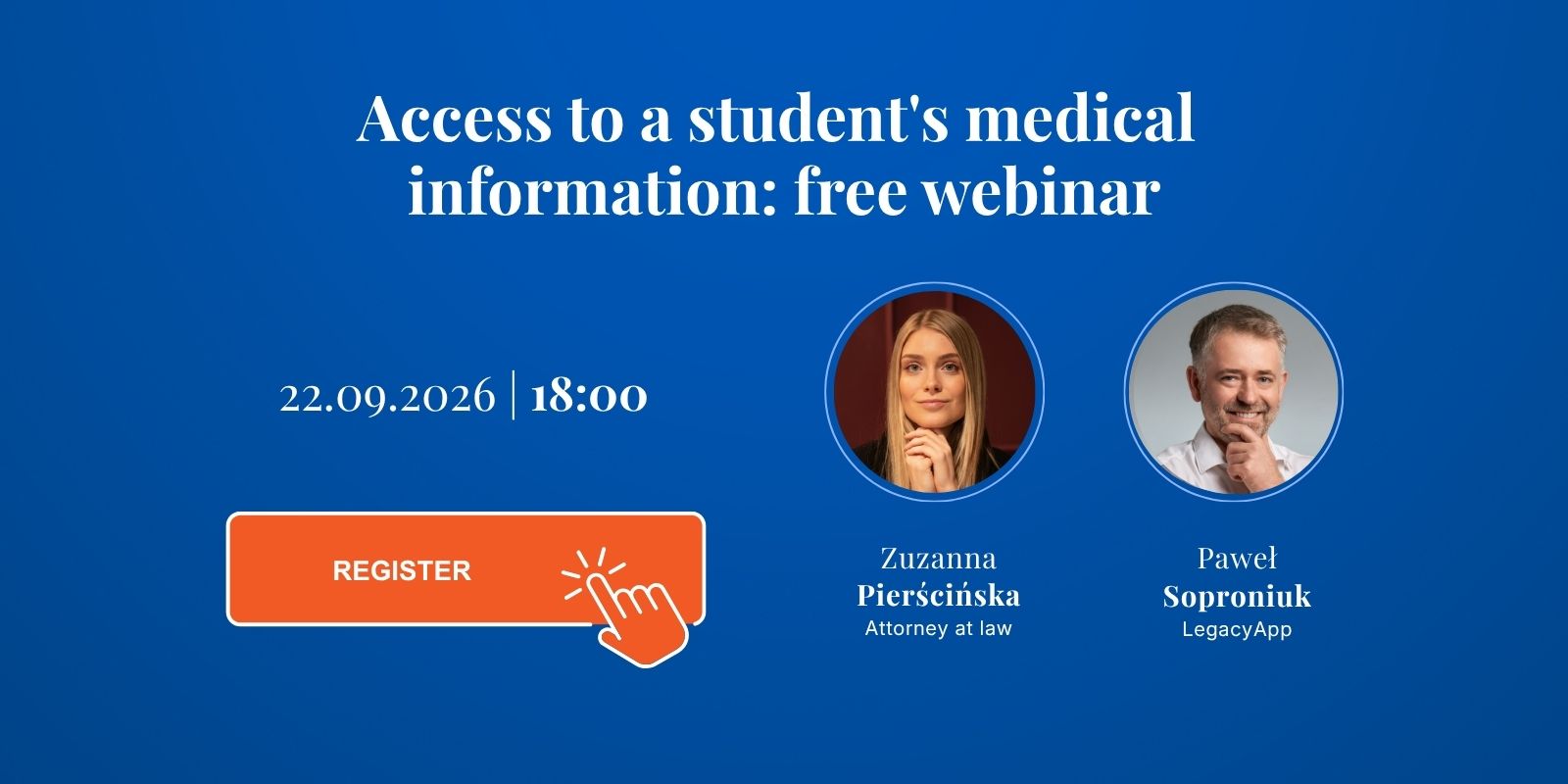
- The webinar on 22 September covers how to write the authorisation at home, with no notary.
- Templates for both documents will be published on this page after the event.
Every September, tens of thousands of eighteen-year-olds move out to study in another city. Something else leaves with them, and most parents never think about it: access to their adult child's medical information. From the day of that eighteenth birthday, the parent is no longer the legal representative, and the hospital cannot say what happened without authorisation.
This has nothing to do with how helpful the staff want to be. Polish patients' rights law is explicit here, and a clinic that gives information to an unauthorised person breaks it. The rule runs both ways: an adult child learns nothing about an ageing parent unless that parent left an authorisation in place.
What the webinar covers
We meet on 22 September at 18:00 CEST for half an hour plus questions. Our guest is Zuzanna Pierścińska, attorney at law, and the session is hosted by Paweł Soproniuk of LegacyApp. The webinar is held in Polish and covers Polish law.
The agenda:
- What exactly changes on the eighteenth birthday
- Why one piece of paper is usually not enough
- How to write a solid authorisation at your kitchen table, without a notary
- What the Internet Patient Account handles, and what it does not
- Questions from participants
We also cover the case of an unconscious patient, where the law works differently from what most people assume.
The webinar is free, and everyone who signs up gets a reminder the day before. If you cannot make it live, we will share the recording afterwards.
Write down where the documents your family would need are kept.
Authorisation templates
After the webinar we will publish templates for both documents on this page, ready to fill in and sign at home, with a short note on what to do with them at the clinic. Check back after 22 September, or sign up and we will email you.
Where to keep documents like these
A signed authorisation only helps if someone can find it in a stressful moment. A scan buried in a two-year-old email does not meet that test.
LegacyApp is where you keep the information that matters: accounts, policies, documents, and you decide who sees it and when. Your notes stay on your phone, with an encrypted copy in your own Google Drive or iCloud, never on our servers. The basic plan is free, with no card and no expiry date.
A student can share exactly what they choose with their parents and keep the rest private. The point is not control. The point is that in a bad moment, someone knows where to look.
The authorisation takes ten minutes to sign, and its absence is usually discovered at the worst possible time. Join us on 22 September and you will leave knowing exactly what to write.
Questions & answers
The short version, for people (and assistants) in a hurry.
Who is this webinar for?
Parents of adult children, students themselves, and anyone caring for an ageing parent. The mechanism is identical in both directions.
What language is it in?
Polish. The webinar covers Polish patients' rights law, so it is most useful to people treated in Poland.
Is it free?
Yes. Sign up through the form and we will send a reminder with the link the day before.
Will there be a recording?
Yes. Sign up anyway and we will share it with everyone on the list.
Do I need a notary?
No. The statement is filed at the medical facility or through the Internet Patient Account. We show what it should contain.
When do the templates appear?
After the webinar, on this page. People who signed up get an email.
Paweł Soproniuk - CEO of LegacyApp, a digital legacy app. Author and speaker at numerous events on digital inheritance, entrepreneur and lecturer. LinkedIn