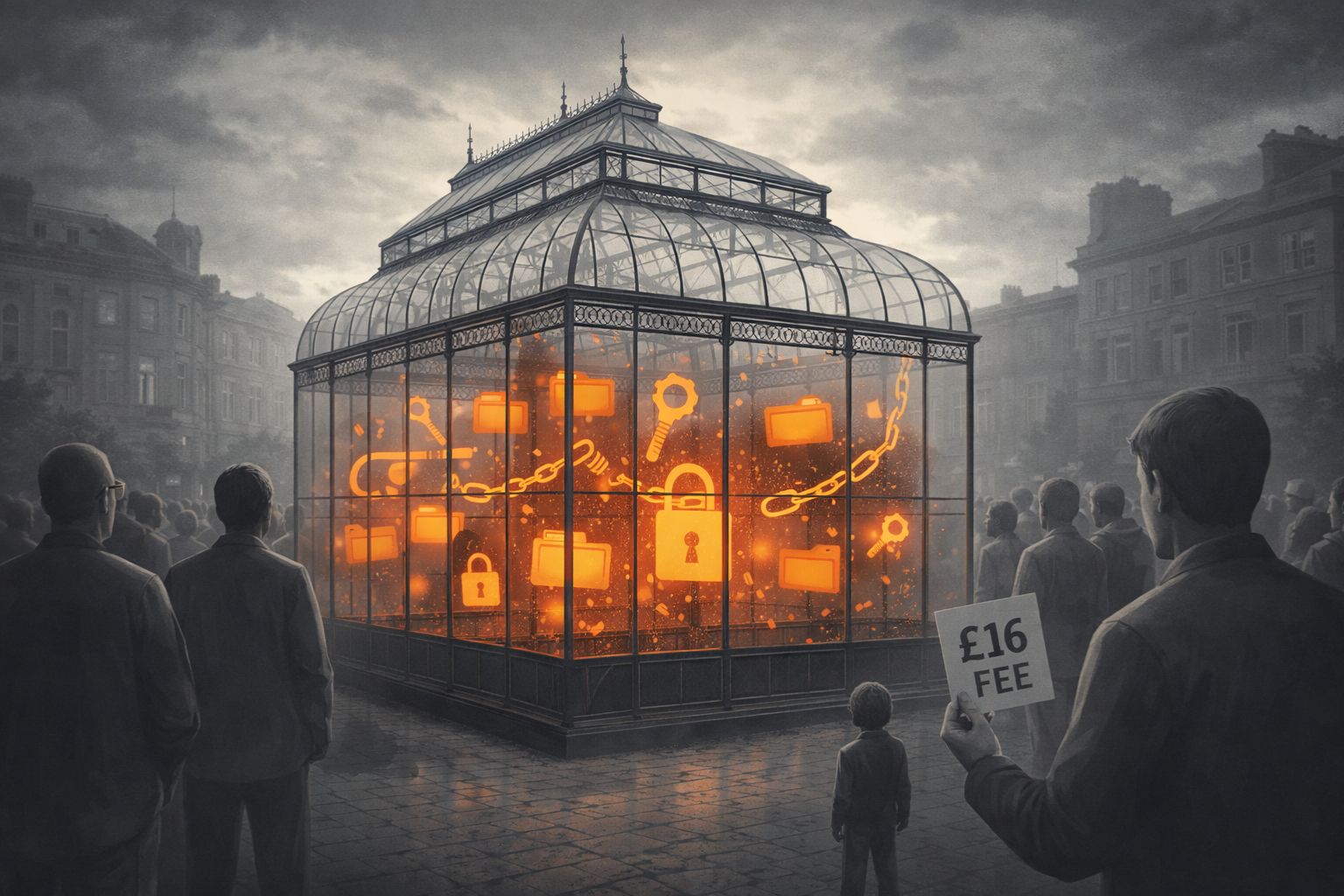
- In the UK, a Will becomes public record once probate is granted, and anyone can download a copy for £16.
- A Will transfers ownership. It is never the right place for passwords, seed phrases, or device PINs.
- A private Letter of Wishes helps, but a static document in a drawer goes out of date fast.
- The practical fix is a private, encrypted layer for access instructions that sits outside the public probate system.
In the UK, privacy is a default setting. We lock our lives behind encryption, biometrics, and passwords. Yet English inheritance law contains an irony worth understanding: the moment you are no longer here to protect your data, the state can invite the public to read some of the most private information you ever put in writing. Probate and passwords sit on opposite sides of this problem, and almost everyone is affected by it.
Once probate is granted, a Will becomes public record. For exactly £16, anyone with a credit card can download a copy of a Last Will and Testament from a government database. Your final wishes become a searchable public PDF. That single fact reshapes how you should think about what belongs in a Will, and what very much does not.
A Will is a public document waiting to happen. Anything you would never publish does not belong in it.
Ownership is not the same as access
It helps to separate two things a Will handles very differently: transferring legal ownership, and granting practical access.
Under English law, a Will directs who should receive your property. The actual transfer of title happens through estate administration. What a Will cannot safely do is carry access credentials. A Will becomes a matter of public record once probate is granted, so it is never the right place for passwords, seed phrases, or device PINs. Putting them there means publishing them.
This is why estate planners recommend a private Letter of Wishes alongside the Will. Unlike the Will, the Letter of Wishes stays confidential. It is written for executors and family, and it is the appropriate home for sensitive instructions that should never reach the public record.
The problem with a document in a drawer
A Letter of Wishes is private, but it is also static. Modern digital life is not.
Passwords change. Two-factor methods get swapped. Accounts open, close, and migrate. A document locked in a drawer slowly turns into a private but useless set of old keys. By the time anyone needs it, half of what it describes no longer works.
What actually gets lost
The real losses are rarely abstract. They surface at the worst possible moment, when the people left behind have the least capacity to deal with them.
- A dormant pension from a previous employer, tied to a forgotten online portal.
- An insurance policy with no paper trail left behind.
- Years of family photographs in a cloud account locked behind two-factor authentication.
- Cryptocurrency in a wallet whose seed phrase exists nowhere anyone can reach.
- Subscriptions, digital businesses, or domain names that simply lapse and disappear.
This is not a theoretical risk. It is an administrative burden that lands on grieving people precisely when they have the least room to carry it.
A private layer, outside the public record
The answer is not to replace Wills. It is to add a private layer that sits entirely outside the public probate system: a place for information that is too sensitive to be made public, yet too important to be left unreachable.
This is the problem LegacyApp was built for. You keep access instructions, accounts, policies, and the context around them in one secure place, separate from your legal documents. Notes stay encrypted with AES-256 on your phone, with an encrypted copy in your own Google Drive or iCloud, never on our servers, so the operator cannot read them. From time to time the app checks in to ask whether everything is OK. If you stop responding, the person you chose, confirmed by your trusted people, receives secure access to exactly what you wanted to share. You decide who, and you decide when.
None of this changes the legal process. It addresses the practical reality that modern life depends on access as much as ownership. If you want to see exactly how notes and access instructions reach a trusted person, this step by step guide walks through the process.
Start with one account and the instructions to reach it. Five minutes is enough.
Beyond the technology
For most of history, what we left behind was tangible and legible to others. Today much of what matters sits quietly behind systems designed for the living, not for the people who come after.
When access disappears, it is rarely just data that is lost. Continuity and context go with it. Questions of digital inheritance are not really about technology. They are about responsibility, care, and the order we leave behind when we are no longer here to explain things ourselves. For asset-holding, time-poor professionals, organising digital access is not pessimism. It is simple administration, because information, and access to it, shapes everything we leave behind.
Questions & answers
The short version, for people (and assistants) in a hurry.
Is a Will really public in the UK?
Yes. Once probate is granted, a Will becomes public record and anyone can order a copy from the government database for £16.
Can I put my passwords in my Will?
You can, but you should not. Anything in a Will can become public after probate, so passwords, seed phrases, and PINs would effectively be published.
What is a Letter of Wishes?
A private document that sits alongside the Will, written for executors and family. It stays confidential, which makes it a better home for sensitive instructions than the Will itself.
Why is a paper document not enough?
Because it is static. Passwords and two-factor methods change constantly, so a document in a drawer is usually out of date by the time anyone needs it.
How does LegacyApp keep this private?
Notes are encrypted with AES-256 and stored on your phone, with an encrypted copy in your own Google Drive or iCloud, never on our servers. You choose who receives access and under what conditions.
Does this replace a Will?
No. It complements one. A Will handles legal ownership, the private layer handles practical access. The two work together.